What is a multi-cloud strategy?
A public cloud is a cloud service that a vendor offers to multiple customers. If Cloud Vendor, Inc., offers their cloud storage product to both Acme, Inc., and Example, Inc., then their service is a public cloud service.
A multi-cloud strategy includes multiple public clouds from different vendors. Acme, Inc. may decide to use other public clouds in addition to Cloud Vendor, Inc.'s service, with different computing workloads or cloud services running in each cloud.

More and more businesses today choose to use a multi-cloud strategy. Managed properly, a multi-cloud deployment can increase reliability, reduce the risk of vendor lock-in, and add essential business capabilities.
What is multi-cloud management?
Multi-cloud management is the process of tracking, securing, and optimizing a multi-cloud deployment. Multi-cloud management presents different challenges than managing one cloud or managing a legacy IT setup. Each public cloud vendor has different features. Each vendor also offers different tools for managing their cloud service, their own APIs, and different service-level agreements (SLAs)*. Internal employees may be experienced with one type of public cloud but not with another. In addition, the disparate clouds have to be connected and secured.
*A service-level agreement (SLA) is a contract that specifies the services a vendor will provide, and the conditions for providing those services.
What is the difference between multi-cloud management and hybrid cloud management?
A hybrid cloud deployment also involves combining multiple clouds. However, the term "hybrid cloud" refers to a combination of two distinct types of infrastructure. A hybrid cloud combines a public cloud with a private cloud or on-premises hardware. Private clouds and on-premises infrastructure give an organization more hands-on control over their cloud servers and cloud security policies. Learn more about hybrid clouds.
How does multi-cloud management work?
Even though they are increasingly common, multi-cloud deployments are relatively new, and tools and best practices for managing multiple public clouds at once are still developing. It is possible for internal IT teams to manage each cloud separately, but this is time-consuming and not ideal. There are very few tools built solely for multi-cloud management, but several more comprehensive modern IT solutions will include multi-cloud management.
Cloudflare aims to simplify many aspects of multi-cloud management by providing a single place for controlling the security, performance, and reliability of a multi-cloud deployment. By combining DNS, load balancing, reliability services, and other essential technologies in one dashboard, Cloudflare can help businesses overcome some of the major challenges of multi-cloud management.
What are the challenges of multi-cloud security?
Multi-cloud introduces a number of security challenges. Each cloud may have different security policies, and vendors may have different safeguards in place. Multi-cloud organizations have to figure out how to apply a consistent, effective security policy across all cloud resources.
Some public cloud providers let their customers configure important security settings themselves. It's crucial that internal teams understand these settings and configure them properly – especially if an IT or DevOps team does not have experience with a certain cloud. Many data breaches have resulted from misconfigured cloud servers (such as the 2019 Capital One breach).
Multi-cloud deployments also share some of the same security challenges faced by any cloud deployment. Unlike traditional on-premises technology, there is no clear network perimeter that a firewall can defend. Instead, a cloud firewall or web application firewall (WAF) should be deployed. User access control is very important as well, since cloud resources can be accessed from anywhere.
How does Cloudflare assist with multi-cloud security?
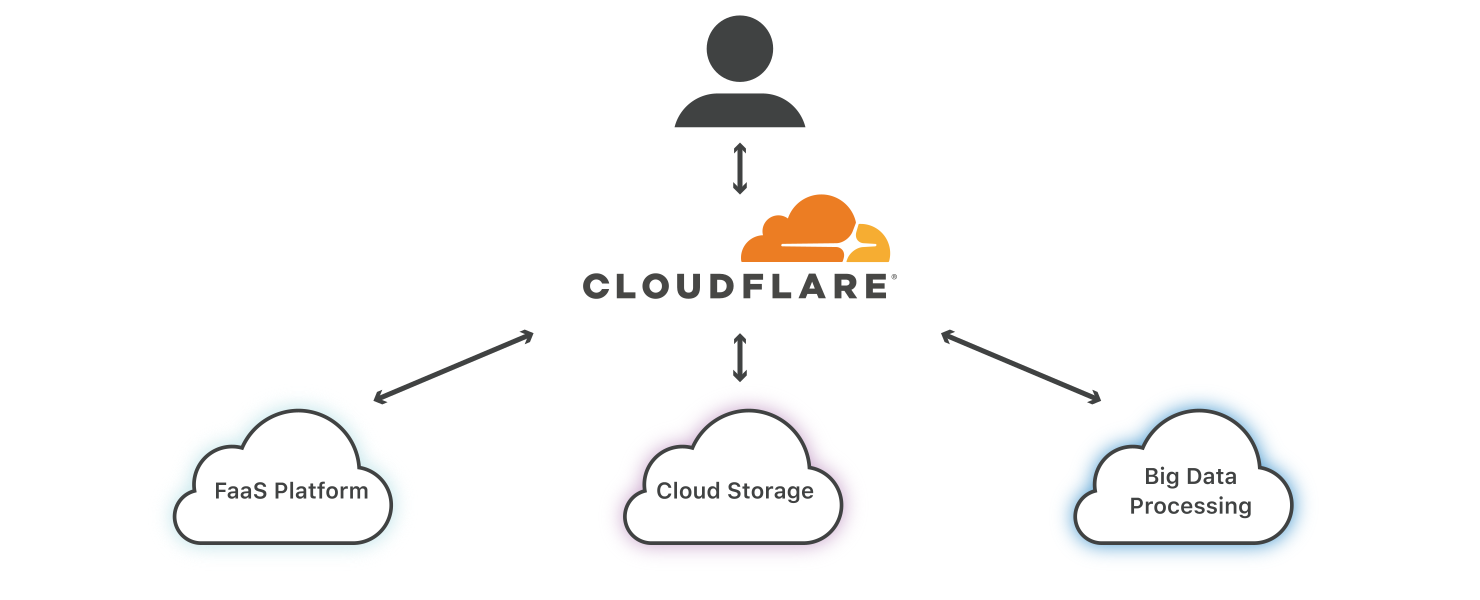
The Cloudflare network provides a variety of infrastructure-agnostic security and performance services for any variety of cloud deployment — including a firewall, access management, and smart routing.
In addition, Cloudflare One is a SASE network-as-a-service which combines many of these individual cloud security and performance services onto a single platform. It uses Cloudflare's global network to provide teams and distributed workforces with secure, fast connectivity to their multi-cloud or hybrid cloud deployments from anywhere on earth.
FAQs
What is multi-cloud management?
Multi-cloud management is the process of monitoring, securing, and optimizing data and applications across several different cloud providers. Because each cloud vendor has its own set of tools and portals, management platforms help IT teams oversee their entire infrastructure from a single point of control.
Why do organizations choose to use multiple clouds?
Companies often use multiple clouds to avoid becoming overly dependent on a single vendor or to take advantage of specific features offered by different providers. This approach also helps improve reliability; if one cloud service experiences an outage, others in the multi-cloud environment can continue to function.
What are the main challenges of managing a multi-cloud environment?
Handling different clouds can be difficult because each provider uses unique configurations, security protocols, and interfaces. Without a unified management strategy, it becomes harder for security teams to maintain consistent protection and for IT staff to track where all their data is stored.
How does a multi-cloud management tool improve security?
These tools allow organizations to apply uniform security policies and configurations across all their cloud platforms simultaneously. This reduces the risk of human error and ensures that security gaps do not open up when data or applications move between different environments.
How can Cloudflare help with multi-cloud management?
Cloudflare acts as a unified layer that sits in front of all a company's cloud providers, providing a single place to manage security, performance, and reliability. By using Cloudflare, businesses can protect their entire infrastructure from a single dashboard, regardless of which underlying cloud vendors they use.