What is data scraping?
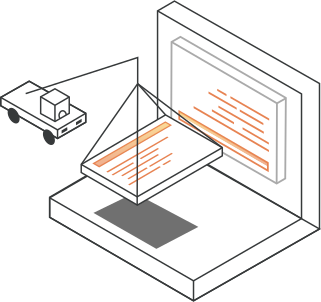
Data scraping, in its most general form, refers to a technique in which a computer program extracts data from output generated from another program. Data scraping is commonly manifested in web scraping, the process of using an application to extract valuable information from a website.
What are different types of web scraping? Why scrape website data?
Scraper bots can be designed for many purposes, such as:
Content scraping - a website’s content is pulled in order to replicate the unique advantage of a particular product or service that relies on content. Take a restaurant review site, for instance; a competitor could scrape all the reviews, then reproduce the content on their own website, pretending the content is original (and reaping the benefits).
Price scraping - by scraping pricing data, competitors are able to aggregate information about their competition. This can allow them to formulate a unique advantage, namely by undercutting their competitors, thus taking their business.
Contact scraping - a lot of websites contain email addresses and phone numbers in plaintext. By scraping pages such as online employee directories, a scraper can aggregate contact details to be used in bulk mailing lists, robo calls, or malicious social engineering attempts. This is one of the primary methods used by both spammers and scammers to find new targets.
What is the difference between data scraping and data crawling?
Crawling refers to the process large search engines like Google undertake when they send their robot crawlers, such as Googlebot, out into the network to index Internet content. Scraping, on the other hand, is typically structured specifically to extract data from a particular website.
Here are 3 differences in behavioral practice between scraper bots and web crawler bots:
Honesty/transparency Advanced maneuvers Respecting robots.txt
Scraper bot Will pretend to be web browsers to get past any efforts to block scrapers. Can take advanced actions such as filling out forms in order to access gated information. Typically has no regard for robots.txt, meaning they can pull content explicitly against the website owner’s wishes.
Crawler bot Will indicate its purpose, wouldn’t attempt to trick a website into thinking the crawler is something it’s not. Will not try to access gated parts of a website. Respects robots.txt, meaning they abide by the website owner’s wishes around what data to parse vs. what areas of the website to avoid.
How are websites scraped?
The process of web scraping is fairly simple, though the implementation can be complex. We can summarize the process in 3 steps:
First, the piece of code used to pull the information (the scraper bot) sends an HTTP GET request to a specific website.
When the website responds, the scraper parses the HTML document for a specific pattern of data.
Once the data is extracted, it is converted into whatever specific format the scraper bot’s author designed.
Typically, companies do not want their unique content to be downloaded and reused for unauthorized purposes, so they might try not to expose all data via a consumable API or other easily accessible resource. Scraper bots, on the other hand, are interested in getting website data regardless of any attempt at limiting access. As a result, a cat-and-mouse game exists between web scraping bots and various content protection strategies, with each trying to outmaneuver the other.
How is web scraping mitigated?
Smart scraping strategies require smart mitigation strategies. Methods of limiting exposure to data scraping efforts include the following:
Rate limit requests - for a human visitor clicking through a series of webpages on a website, the speed of interaction with the website is fairly predictable; you’ll never have a human browsing 100 webpages a second, for example. Computers, on the other hand, can make requests that are orders of magnitude faster than a human, and novice data scrapers may use unthrottled scraping techniques to attempt to scrape an entire website very quickly. By rate limiting the maximum number of requests a particular IP address can make over a given window of time, websites are able to protect themselves from exploitative requests and limit the amount of data scraping that can occur within that window.
Modify HTML markup at regular intervals - data scraping bots rely on consistent formatting in order to effectively traverse website content and parse out data. One method of interrupting this workflow is to regularly change elements of the HTML markup. By nesting HTML elements, or changing other aspects of the markup, simple data scraping efforts will be hindered or thwarted. For instance, some websites will randomize some form of content protection modification every single time a webpage is rendered; others may update their front-end every few weeks to prevent longer-term data scraping efforts.
Use challenges for high-volume requesters - another useful step in slowing content scrapers is requiring website visitors to answer a challenge that’s difficult for a computer to surmount. While a human can reasonably answer the challenge, a headless browser* most likely can’t, certainly not across many instances of the challenge.
- Another less common mitigation method calls for embedding content inside media objects like images. Because the content does not exist in a string of characters, copying the content is far more complex, requiring optical character recognition (OCR) to pull the data from an image file.
*A headless browser is a type of web browser, much like Chrome or Firefox, but it doesn’t have a visual user interface by default, allowing it to move much faster than a typical web browser. By essentially running at the level of a command line, a headless browser is able to avoid rendering entire web applications. Data scrapers write bots that use headless browsers to request data more quickly, as there is no human viewing each page being scraped
How is web scraping stopped completely?
The only way to guarantee a full stop to web scraping is to stop putting content on a website entirely. However, using an advanced bot management solution can help websites eliminate access for scraper bots.
Protect against scraping attacks with Cloudflare
Cloudflare Bot Management uses machine learning and behavioral analysis to identify malicious scraping activity, protecting unique content and preventing bots from abusing a web property. Similarly, Super Bot Fight Mode is designed to help smaller organizations defend against scrapers and other malicious bot activity, while giving them more visibility into their bot traffic.
FAQs
What is data scraping?
Data scraping is a technique where a computer program extracts data from the output of another program. A common form of this is web scraping.
What are the different types of web scraping?
Web scraping can be used for many purposes, including: Content scraping: An attacker pulls a website's content to replicate it on their own site. Price scraping: A competitor scrapes pricing data to gain an advantage by undercutting prices. Contact scraping: A bot gathers contact details like email addresses and phone numbers from websites to be used for spam, robo calls, or malicious social engineering.
What is the difference between data scraping and web crawling?
Web crawling is the process used by large search engines to index Internet content, and crawler bots are generally transparent about their purpose. Data scraping, on the other hand, is typically designed to extract specific data from a particular website.
How do websites get scraped?
The process typically involves three steps. First, a scraper bot sends an HTTP GET request to a website. Second, when the website responds, the scraper parses the HTML document to find a specific pattern of data. Finally, the extracted data is converted into a specific format designed by the bot's author.
How can data scraping be mitigated?
Several strategies can limit exposure to data scraping. These include rate-limiting requests to block abnormally fast traffic from a single IP address, regularly modifying a website's HTML markup to disrupt simple scrapers, and using challenges like CAPTCHAs for high-volume requesters.
Can web scraping be stopped completely?
Using an advanced bot management solution can help websites eliminate access for scraper bots. Cloudflare Bot Management, for example, uses machine learning and behavioral analysis to identify and stop malicious scraping activity.