What is network-as-a-service (NaaS)?
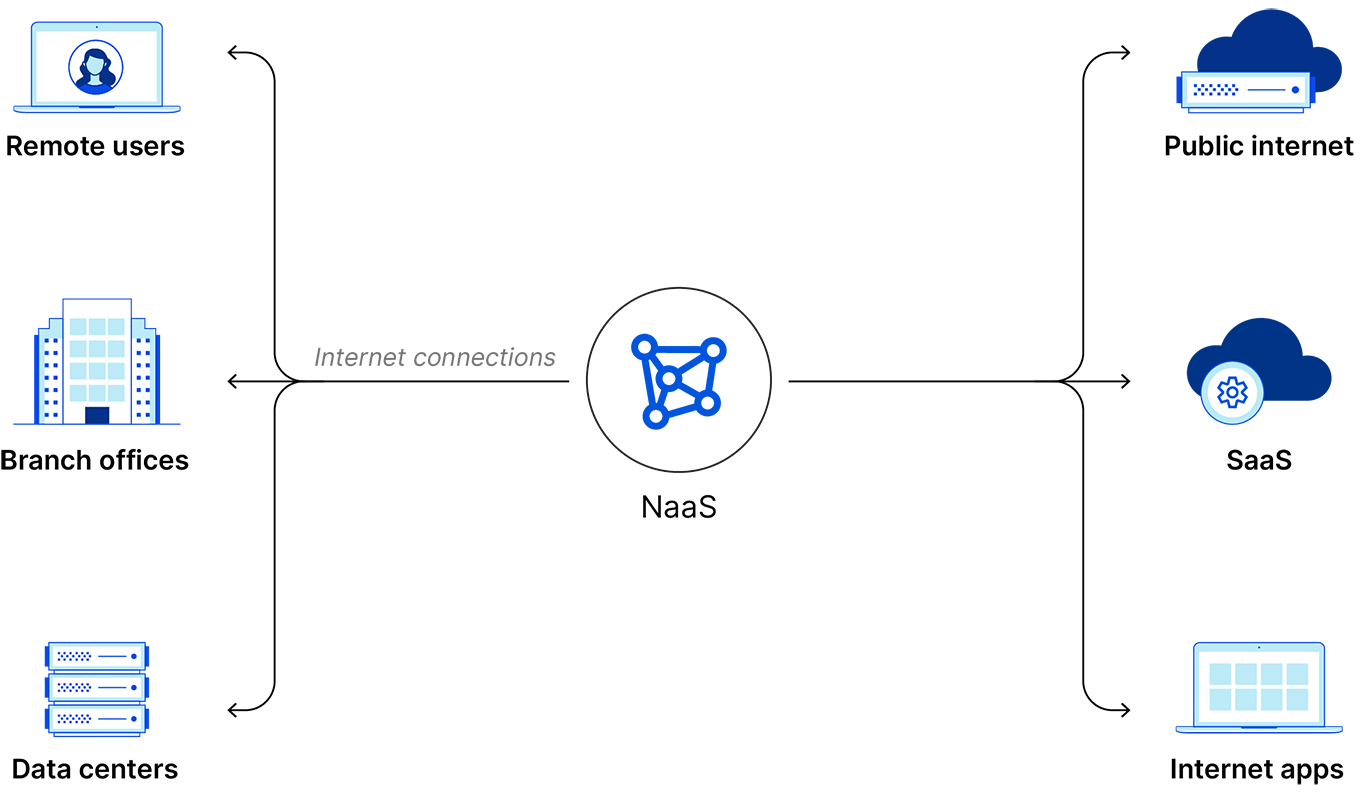
Network-as-a-service (NaaS) is a cloud service model in which customers rent networking services from cloud providers. NaaS allows customers to operate their own networks without maintaining their own networking infrastructure.
Like other cloud services, NaaS vendors run networking functions using software, essentially allowing companies to set up their own networks entirely without hardware. All they need is Internet connectivity.
NaaS can replace virtual private networks (VPNs), multiprotocol label switching (MPLS) connections, or other legacy network configurations. It can also replace on-premise networking hardware such as firewall appliances and load balancers. A newer model for routing traffic and applying security policies, NaaS has had a major impact on enterprise networking architecture.
How did NaaS develop?
When most enterprises were configuring their network infrastructure, the Internet itself was not considered a trusted place to conduct business. So they built their own internal private versions of the Internet and connected facilities to one another with rented links. They needed to configure their own wide area networks (WANs), and each office location needed its own hardware for firewalls, DDoS protection, load balancing, and so on. Enterprises also needed to set up dedicated connections between each location using a method such as MPLS.
When employees connected to the Internet instead of the internal network, their traffic had to first go through the corporate networking infrastructure via a VPN before it could go out to the Internet. For instance, if a company's headquarters were in Austin, Texas and a company employee in a branch office in New Orleans, Louisiana needed to load a website, their HTTP request for the website would travel through the corporate VPN, across an MPLS link to the headquarters in Austin (about 800 kilometers away), and then out to the wider Internet.
This model quickly became inefficient as some business activities began moving into the cloud. For instance, imagine the New Orleans employee frequently used a SaaS application, meaning they needed to load content over the Internet constantly. Their requests, and the requests of other employees, would become bottlenecked in the Austin data center, slowing down network service.
In addition, more capabilities have become available through the cloud as cloud computing becomes more efficient. Today, DDoS mitigation, firewalls, load balancing, and other important networking functions can all run in the cloud, eliminating the need for internal IT teams to build and maintain these services.
For these reasons, NaaS is a more efficient option than relying on internally maintained WANs that require constant maintenance and often create bottlenecks for network traffic. With NaaS, company employees can connect to their cloud services directly through a virtual network that an external vendor manages and secures, instead of internal IT teams attempting to keep up with the demand for network services.
If our example company switches to a NaaS model, the New Orleans-based employee no longer has to wait for their web traffic to travel through all the internal corporate infrastructure. Instead, they simply connect to the Internet and sign in through a browser, and they can access all the cloud services they need. Meanwhile, the NaaS provider secures their browsing activity, protects their data, and routes their web traffic wherever it needs to go, as efficiently as possible.
In many ways, NaaS is the logical result of several decades of business processes migrating to the cloud. Today the whole network can be offered as a service, instead of just software, infrastructure, or platforms.
What are the challenges of NaaS?
Compatibility: The NaaS vendor's infrastructure may not be compatible with legacy systems that are still in place — older hardware, on-premise-based applications, etc.
Legacy data centers: In many enterprises, important applications and processes still run in on-premise data centers, not the cloud. This makes migration to a NaaS model slightly more challenging (although services such as Cloudflare Network Interconnect can help overcome this challenge).
Vendor lock-in: Moving to a cloud service always introduces the risk that an enterprise may become too reliant on that particular service provider. If the service provider's infrastructure fails or if they raise their prices, vendor lock-in can have major repercussions.
What are the advantages of NaaS?
Flexibility: Cloud services offer more flexibility and greater customization. Changes are made to the network via software, not hardware. IT teams are often able to reconfigure their corporate networks on demand.
Scalability: Cloud services like NaaS are naturally more scalable than traditional, hardware-based services. Enterprise NaaS customers can simply purchase more capacity from a vendor instead of purchasing, plugging in, and turning on more hardware.
Access from anywhere: Depending on how a cloud-based network is configured, users may be able to access it from anywhere — and on any device — without using a VPN, although this introduces the need for strong access control. Ideally, all a user needs is an Internet connection and login credentials.
No maintenance: The cloud provider maintains the network, managing software and hardware upgrades.
Bundled with security: NaaS makes it possible for a single provider to offer both networking services and security services like firewalls. This results in tighter integration between the network and network security.
Cost savings: This advantage depends on the vendor. However, purchasing cloud services instead of building one's own services often results in cost savings: cloud customers do not need to purchase and maintain hardware, and the vendor already has the servers they need to provide the service.
How does NaaS relate to SASE?
Secure access service edge (SASE) combines software-defined networking with network security functions, all offered via a single service provider. As with NaaS, SASE hosts networking functions in the cloud and combines them with security functions. In many ways NaaS and SASE are similar models for how more and more enterprises are operating today.
What is Cloudflare WAN?
Cloudflare WAN is an enterprise NaaS solution that is designed to be secure, fast, and reliable. It is a network security solution built to replace hardware appliances and WAN technologies with a single network. Learn more about enterprise networking with Cloudflare WAN.
FAQs
What is network-as-a-service (NaaS)?
NaaS is a cloud service model where customers rent networking services instead of setting up physical networking infrastructure. This approach allows businesses to operate their networks entirely through software, eliminating the need to maintain hardware like routers or switches.
How does the NaaS model differ from traditional networking?
In a traditional setup, organizations build their own internal private wide area networks using rented links and on-premises hardware. NaaS replaces these legacy configurations with virtual functions managed by a cloud vendor. Users simply connect to the Internet and log in via a browser to access their resources.
What are the advantages of adopting a NaaS solution?
NaaS offers several benefits, including improved scalability, simplified management, and potential cost savings. Because the provider handles all software and hardware upgrades, internal teams are freed from maintenance tasks. Additionally, many NaaS solutions bundle security services, like firewalls, directly into the network.
Does NaaS help improve the experience for remote employees?
In a legacy network architecture, traffic from remote users often has to travel through central corporate infrastructure, creating bottlenecks and adding unnecessary latency. With NaaS, employees can connect directly to their cloud services through a secured virtual network. This reduces latency and ensures they can access the tools they need as efficiently as possible from any location.
Can NaaS replace hardware-based security appliances?
NaaS can replace physical firewall appliances, DDoS protection hardware, and load balancers. By moving these functions to a cloud-native environment, organizations can apply security policies and route traffic without managing individual pieces of hardware at every office location.
What is the relationship between NaaS and SASE?
NaaS and secure access service edge (SASE) are related concepts in modern network architecture. SASE combines software-defined networking with comprehensive security functions like Zero Trust Network Access and secure web gateways into a single cloud-delivered service.
Are there any challenges to consider when switching to NaaS?
While NaaS offers great flexibility, it does introduce a dependency on the service provider's infrastructure. It also requires organizations to ensure their chosen vendor maintains high security standards for data transmission and has minimal service outages.